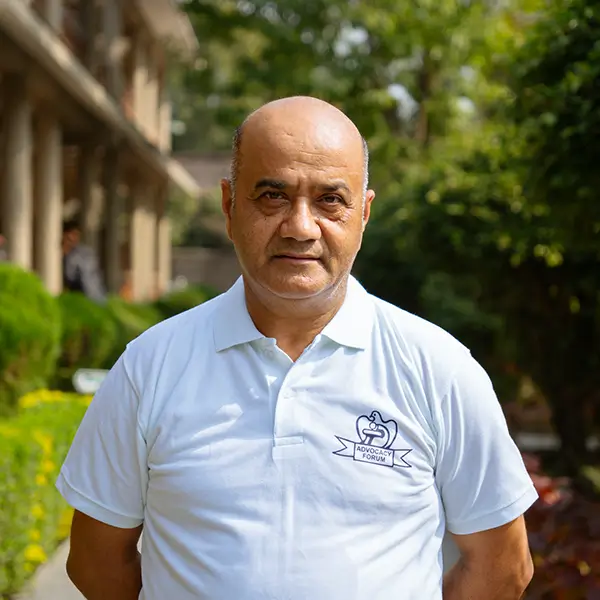
May 28, 2021, Nepalgunj: Advocacy Forum Nepal’s Advocate Basanta Gautam monitored some of the detention centers from the Human Rights perspective in the context of the COVID-19 pandemic. The main objective of the monitoring was to find out the condition of the detainees and their overall human rights status. Area Police Office (APO) Dhaunauli, APO Jamunaha, APO Kohalpur, District Police Office (DPO), and the Prison of Banke were monitored via media reports and telephone inquiries The information was collected from May 24 to 26, 2021.
Initially, Banke District was the hot spot of the second wave of the COVID-19 pandemic and subsequently became the first District to announce the lock-down and prohibitory orders in Nepal.With the rapid surge in COVID-19 cases all over the country, the prohibitory orders were announced as per the needs of the Local Governments/administrators. AF’ss earlier reports have shown that detention centers in Banke are often overcrowded with a number of detainees extending their capacity. Though the present statistics show that this number has reduced, the condition of detention centers and prisons that were monitored still have issues which are detailed below along with the table chart.
AF monitored five detentions including a Prison Office where there 849 males are found currently detained/prisoned and the COVID-19 status is mentioned at the table below:

Findings of the monitoring:
- There are altogether 849 males detained and imprisoned in 4 detention centers and 1 Prison of Banke district. There are no female detainees in either of them. a
- Altogether 19 cases of COVID-19 are reported out of which 18 are active and 1 is normal. However, no one had to be hospitalized yet.
- In the Prison office,40 cases of seasonal flu (fever and cough) were reported. However, no PCR tests were conducted, rather they were isolated and given medications. Later, they are placed in their regular cell.
- In APO Jumanaha, all detainees are infected by COVID-19 but they are not reported to be serious and they are normally isolated and given medication according to their seriousness.
- It is found that no one has been hospitalized yet and it is observed that no health workers have been mobilized for the proper care and treatment of the detained patients. Overall the situation is not found satisfactory from the point of view of COVID-19 management and human rights perspective.
Applied Measures to Mitigate the infections:
The detainees of the minor cases and the juveniles are handed over to their parents/family members.
- Jail bail hearing is done via online presence.
- Only the detainees whose PCR tests results are negative, are presented at the Court
- Health protection measures are being applied but not adequately
- The detainees are allowed to contact their family members with phone calls and the food brought by the visitors is provided after proper checking.
Conclusion and Recommendations:
AF has been monitoring the government detention facilities with an aim to prevent torture and ill-treatment at detention facilities. From the monitoring, it is found that even the very basic needs such as food, clothes, sanitation, safe drinking water, toilet facilities are not provided adequately for the detainees. These basic needs along with the right to access health services, a fundamental right enshrined in the Constitution of Nepal must be fulfilled, more so at the present time of the COVID-19 pandemic. From the monitoring, it is clear that the detainees are not tested for COVID-19 infection unless they are seriously ill. Prisoners are suffering from skin diseases due to the lack of proper sanitation facilities. Bedbug problem is one of the most common problems at prisons and detention facilities. The government food facility does not address the minimum nutrition needs of the detainees/prisoners. Basically, the minimum standards of human rights are not fulfilled. Thus, regular follow-up and providing suggestion to the concerned authority for required reform is always essential.
In this context, AF has the following recommendations to overcome the problems:
- Basic needs and facilities should be ensured at all Prisons and detention facilities.
- In this current pandemic situation, at least, prisons should not be populated surpassing their capacity. Government and the concerned authorities should prepare sustainable plans to address the problems and find out the long-term solution.
- Current pandemic should be managed as per the WHO standards and the existing local government’s guidelines. Regular health checks up, Health workers follow up, quarantines and isolations management, etc. is the must.
- Human rights measures must be ensured compulsory in each and every prison and detention facility.
- Continuous follow-up by the responsible authorities and addressing the problems is necessary.